top of page

LESS PELLETS AND MORE MILK – IN A FREE FLOW BARN

  • 2 days ago
  • 2 min read

Guided flow barns using robots without pellets have gotten a lot of attention in the last year. This has free flow farms wondering if the can feed less pellets. No-feed works in guided-flow because cows move around the barn to get to the feed bunk. As they move, some of the trips to the bunk include a detour to the robot. Cows are trained to find their way through the selection gate, or through the robot, to get to the bunk. The feed in the bunk motivates cows to move through the robot. By contrast, in a free-flow barn the feed offered in the robot motivates cows to move to the robot. The feed in the free-flow robot cannot be eliminated, but there may be opportunities to feed less. The strategy for feeding less depends on the demographics of the herd or pen.

The partial mixed ration in a free-flow group is formulated for an energy deficit for the majority of the cows. Cows go to the robot to balance that energy deficit. Cows that do not have an energy deficit are much more likely to require fetching than cows that do have an energy deficit. The production demographics of the pen determine where robot feed can be reduced. The strategy for a pen with diverse production levels will be different from the strategy for a pen with uniform production levels. Here are 2 examples.


In a hypothetical mature cow pen averaging 90 pounds per cow, with high peak milk and

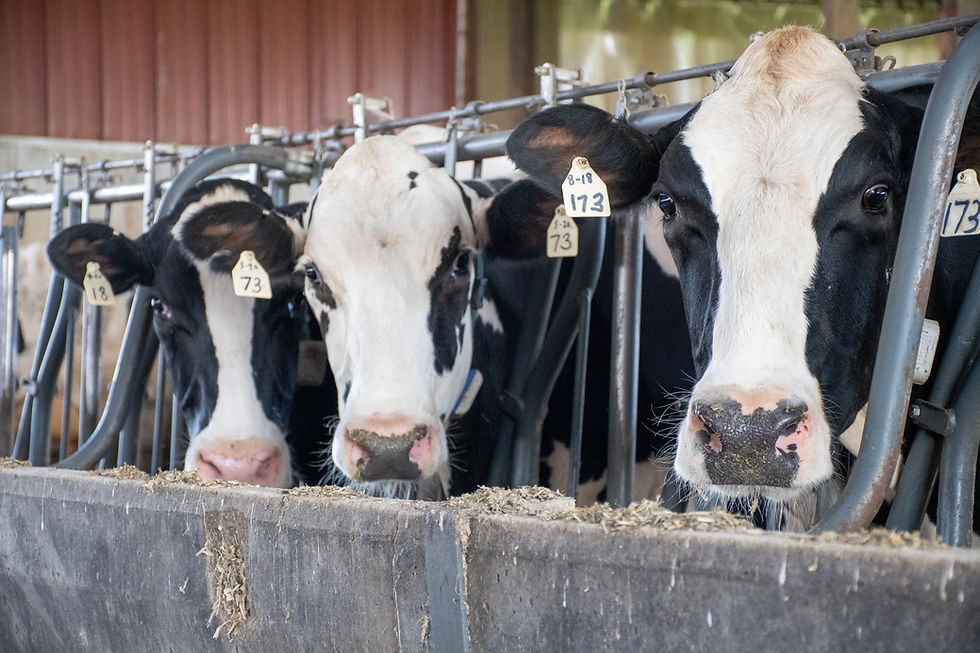
Cow at the feed bunk

marginal persistency, individual cows might range from 40 to 160 pounds per day. If the bunk is balanced for 70 pounds, a significant number of cows producing less than that will be overfed in the robot. Anecdotal experience suggests that feeding 4 to 6 pounds in the robot will still motivate many lower producing cows to be milked. Recently I worked with a herd that allowed late lactation cows more than 8 pounds of feed in the robots. We adjusted the feed tables to take 2 pounds away from the late lactation cows. We reallocated some of that feed to early lactation cows and increased milk per cow. Average pellet intake was reduced from 10.3 pounds per cow to 8.8 pounds per cow. Pounds of milk per pound of pellet increased by more than 20%. As margins tighten, it makes sense to review feed tables to make sure the right cows are getting the right amount of feed.


By contrast, a very uniform, persistent group of first lactation heifers might average 85 pounds with a range of 70 to 120 pounds. The bunk could be balanced for 80 pounds and very few cows would be significantly overfed. The top producing cows would require less pellets because more of their needs could be met in the bunk. Grouping strategies, persistent cows, and efficient reproduction can all help to create more uniform groups with more of their nutritional requirements supplied by the partial mixed ration.


Free-flow barns still require more feed in the robot than guided-flow barns. Many free-flow barns can minimize the feed required in the robot by reviewing feed tables, and optimizing grouping strategies. Cow Corner can help with either one.


READ NEXT:

SUBSCRIBE:
Get info like this and more delivered to your inbox each month! 

LOOKING FOR EVEN MORE?
We also offer a premium subscription, delivering robotic milking insights four times per month. 

bottom of page