
ROBOTIC FARM FEATURE – TER WOERDS FARMS LTD.
Ter Woerds Farms is located in southern Ontario, east of Lake Huron. From their immigration from Holland, to adopting robotic milking, switching from free flow to guided flow, adjusting feeding strategies, and incorporating new technologies, change has been a constant. Stan recently sat down with us to record an episode of the Worldwide Robotic Milking podcast. Here are some of the things we talked about.
Stan and his family moved from Holland to Ontario in 2006, when he was 8 years old. The family was looking for a new home for their dairy, so they loaded home furnishings and farm equipment into 2 shipping containers and came to Canada. In the first year they bought cows and quota, and began milking in an old used parlor.
By 2010, they were ready to replace the aging parlor and transition to robotic milking. They
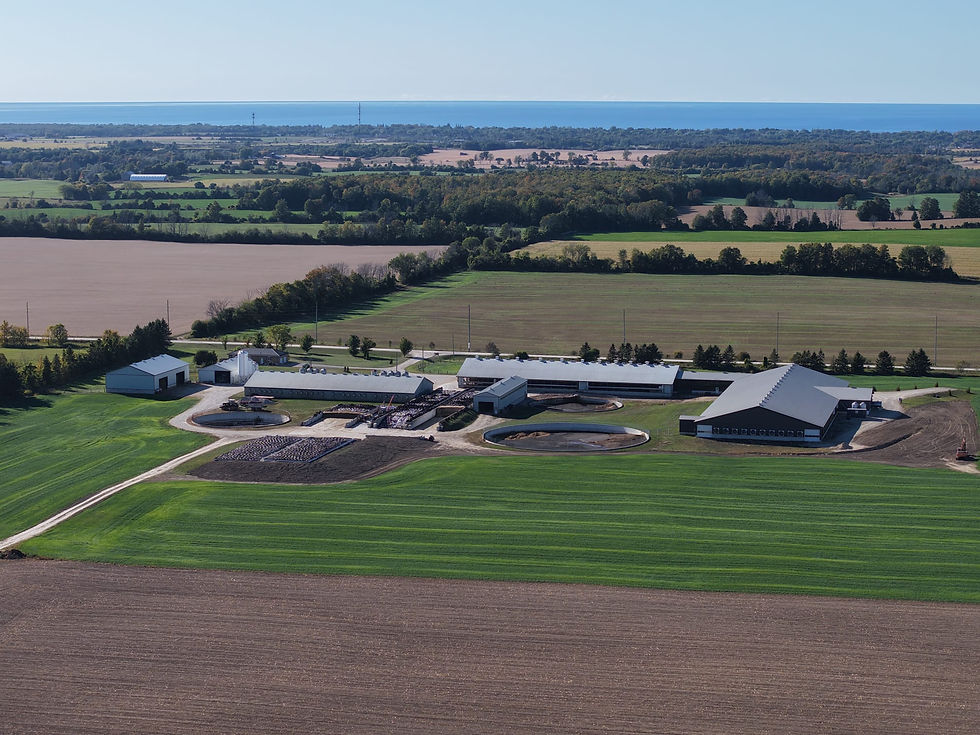
started with 1 unit retrofitted into an existing barn with free flow traffic. 3 years later they had grown to the point that they needed another robot. In 2023 that barn started to get crowded so they started looking at other options. Stan toured some guided flow barns in Wisconsin, and made up his mind that this would be the next step. He liked the idea of feeding less in the robot. What really intrigued him was the opportunity for his cows to get more of their energy from his high-quality forages, and less from the feed in the robot.
They moved into the new barn in 2024. It is a four row, fully guided barn. There are 2 pens with 60 sand bedded stalls per pen. Each pen has a separation area with 8 free stalls. Most management tasks are completed in the separation area. Separation pens are also used for training new heifers.
Initially, the goal was to reduce the average robot feed from 11 pounds to 4.5 pounds. That worked well so they gradually reduced the robot feed until it was completely eliminated. Cows maintained milk production without feed in the robots, but Stan found that it was harder to train cows, and cows spent more time in the commitment pen. He has settled at about one half pound per cow, and he believes cows move into the robot more quickly with that incentive. With only 6% idle time, it seems to be working.
Stan expected that it would take a while to acquire quota and grow into the new barn. As it turned out, they quickly reached 75 cows per robot by milking for neighbors who needed help during building and remodeling projects. Those extra cows tested the capacity of the system. The Ter Woerds’ robots are equipped to increase the system vacuum level during peak milk flow, which helps to maintain constant teat end vacuum. The system reduced milking duration by about 30 seconds per cow, so they could milk 7 to 8 more cows per robot. The more stable vacuum has also reduced the number of kickoffs.
The robots are also equipped with progesterone monitoring to find cows in heat, diagnose abnormal cycles, and check pregnancies. The robot measures progesterone in real time from milk samples collected at programmed intervals. A cow with elevated progesterone has a corpus luteum on her ovary. In the simple terms, a cow with a corpus luteum is most often either between heats or pregnant, depending on her history. Progesterone monitoring improves accuracy, and minimizes the number of cows touches needed for reproductive management.
All of this technology does make the system more complicated, but it allows the farm to operate on family labor. Stan says, “It’s not like we’re spending tons of time in the barn. The way we have things set up is pretty efficient. Everything is designed for labor efficiency.”
Listen for more from Stan Ter Woerds on an upcoming episode of the Worldwide Robotic Milking podcast.


Comments