ROBOTIC FARM FEATURE: FOUR CUBS FARM
- john28855
- 4 minutes ago
- 3 min read
Four Cubs Farm is located in Grantsburg, Wisconsin, about 80 miles northeast of Minneapolis, Minnesota. The farm is owned by Gary and Cris Peterson, and their son Ben. Nathan Brandt is the herd manager. They converted to robots in 2018 after fire completely destroyed their parlor. Following the fire, all of the cows were milked and housed on other farms until the renovation was complete. Cows returned home in groups as sections of the barn were completed. The current milking facility has 8 pens with 2 Lely A4’s per pen.

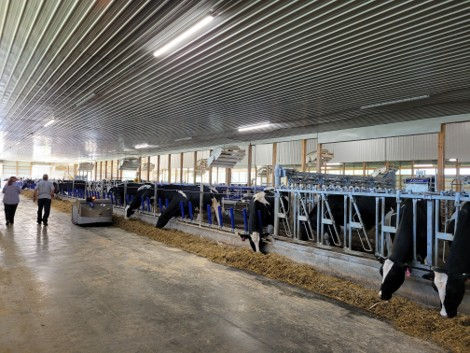
There were no milk checks while the cows were housed on other farms. Going through a year without milk income sharpened the team’s management skills. They weathered that storm, and it has made them more determined to set themselves up to weather any storm in the future. Ben and Nathan participate in a benchmarking group, and their goal is to keep their profit per cow in the top 1% of that group. They believe in comparing themselves to the best and never allowing themselves to become comfortable with their success. They are meticulous about record keeping, and those records give them confidence to accurately forecast the impact of changing markets, new management practices, and facility improvements.
One recent improvement was the construction of a completely enclosed feed mixing center.
This building has allowed them to reduce the shrink on their commodity feeds to less than 1½%. For reference, the industry standard for commercial feed mills is closer to 4%. If you doubt their numbers, consider that everything is weighed on-farm when it arrives, and again when it is mixed and loaded for feeding. The on-farm weights also mean that they know their exact forage inventory. They can accurately predict when a forage change will occur and manage it to minimize the effect on cow traffic in the free-flow barn. They also use the feed center to blend the commodities they feed in the robots. The mix can be adjusted on farm, as needed, to complement the rest of the ration.
Another improvement has been the inclusion of roasted high oleic soybeans in the ration. High oleic soybeans can be fed at higher levels than conventional soybeans be

cause the fatty acid balance is genetically modified to include less linoleic acid. Oleic acid does not interfere with rumen digestion like linoleic acid does. The high group ration at Four Cubs farm includes 13% roasted high oleic soybeans on a dry matter basis. Other farms have included high oleic beans to improve their butterfat. Ben says the extra energy from the fat in the soybeans has also improved reproductive performance.
Training heifers to the robots is a high priority. The heifer training protocol was recently updated. Heifers did well with the old protocol, which involved distributing fresh heifers to all 8 special needs pen for 10 days of 4X training. Recently, the special needs areas for 2 milking pens were combined to make one area, with access to 2 robots. The combined area is large enough to train all of the heifers in one place. This requires less labor and makes it easier to monitor the fresh heifers. Heifers spend about 20 days in a dedicated fresh cow pen after they leave the special needs area.
The management team at Four Cubs Farm is constantly re-evaluating every decision and looking for new opportunities. No detail is too insignificant. Having been through the fire – both literally and figuratively – their goal is to generate a profit, even in the worst years.


